


Redefining Fitness: Moving Through Pain, Not Past It
- Marcie O
- Jun 24, 2025
- 8 min read

Let’s talk about something that doesn’t get said enough: working out doesn’t have to look like the gym, the grind, or the glossy before-and-after photos. For some of us, working out means stretching while sitting on the bed. It means using a cane one day and doing chair yoga the next. It means redefining what “movement” even looks like when your body is in constant pain, and your mind is still reeling from things you haven’t had the space or safety to heal from.
My Story: Pain, Fatigue, and the Fight to Keep Going
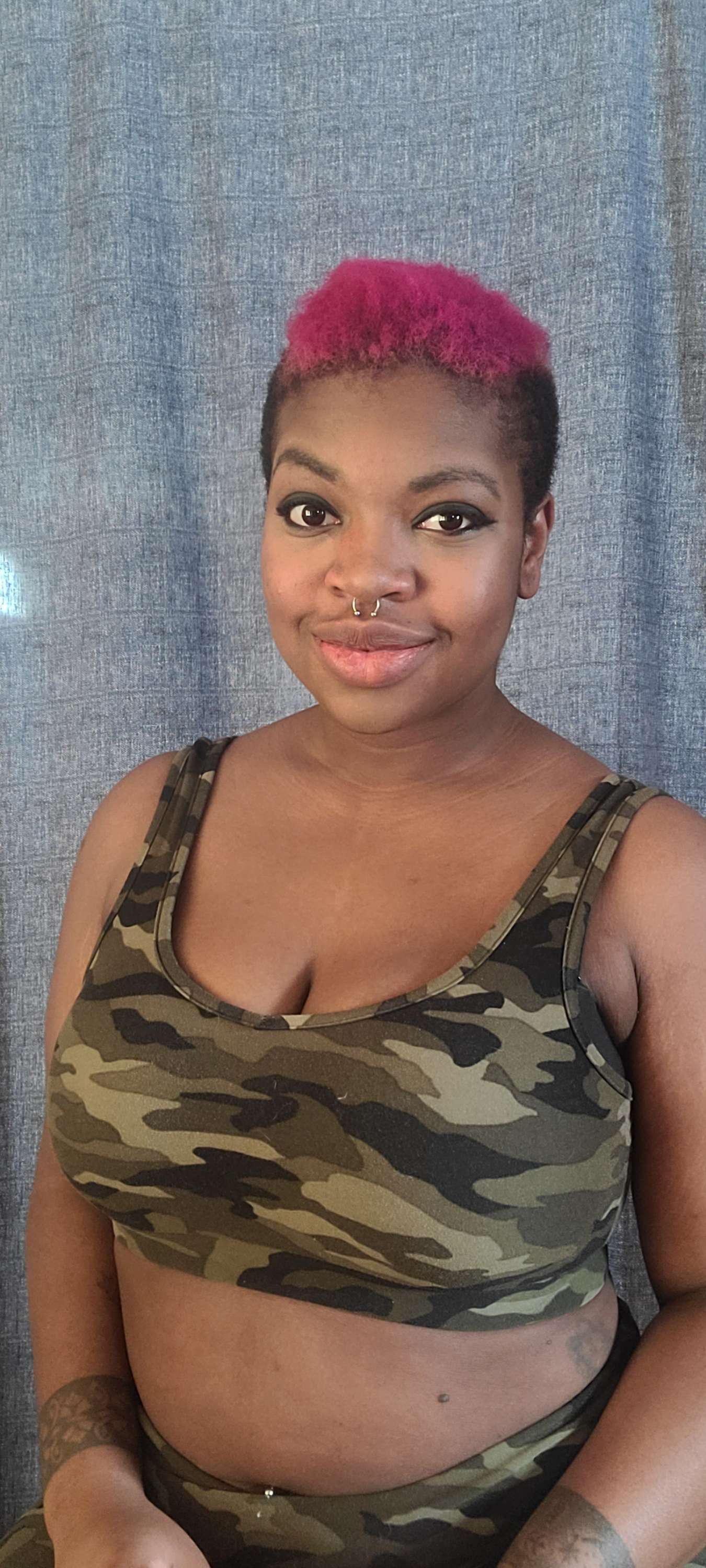
If you don’t know me yet—hi, I’m Marcie. I’m 30, Black, bi/pan, chronically in pain, and mentally tired as hell most days.
I've lived through multiple car and work accidents, arthritis, and the type of fatigue that makes it hard to explain why getting out of bed feels like climbing a damn mountain. CPTSD and depression aren’t cute little buzzwords in my bio—they’re real shadows I live with.
There are days I genuinely can’t lift my arms over my head.
Days I use a cane.
Days I’ve whispered (and meant it), “I’d give anything to make this stop.”
But here’s the thing I’ve learned the hard way: if I stop moving, the pain gets worse.
I’m not talking about pushing myself to the edge or “no pain, no gain” BS.I mean gentle movement—stretching, walking, breathing through the ache when I can, resting when I can’t.
Some of you might know I lost over 20 inches before. I was doing yoga, HIIT, cardio, walking.
Then I got sick. COVID hit hard—not once, but repeatedly. The household kept cycling it for almost four months.
I barely moved some days. I barely ate.
And when I started to feel better? My body had changed. I gained back what I lost.
And the pain came back tenfold.
But this is real life. Not a transformation reel.
Things happen.
Setbacks happen.
Fitness Isn’t One-Size-Fits-All
For those of us living with chronic pain, injury, CPTSD—or all of the above—fitness doesn’t look like Instagram.
It’s not all aesthetic gym selfies or marathon prep vlogs.
It’s real, raw, and deeply personal.

It looks like:
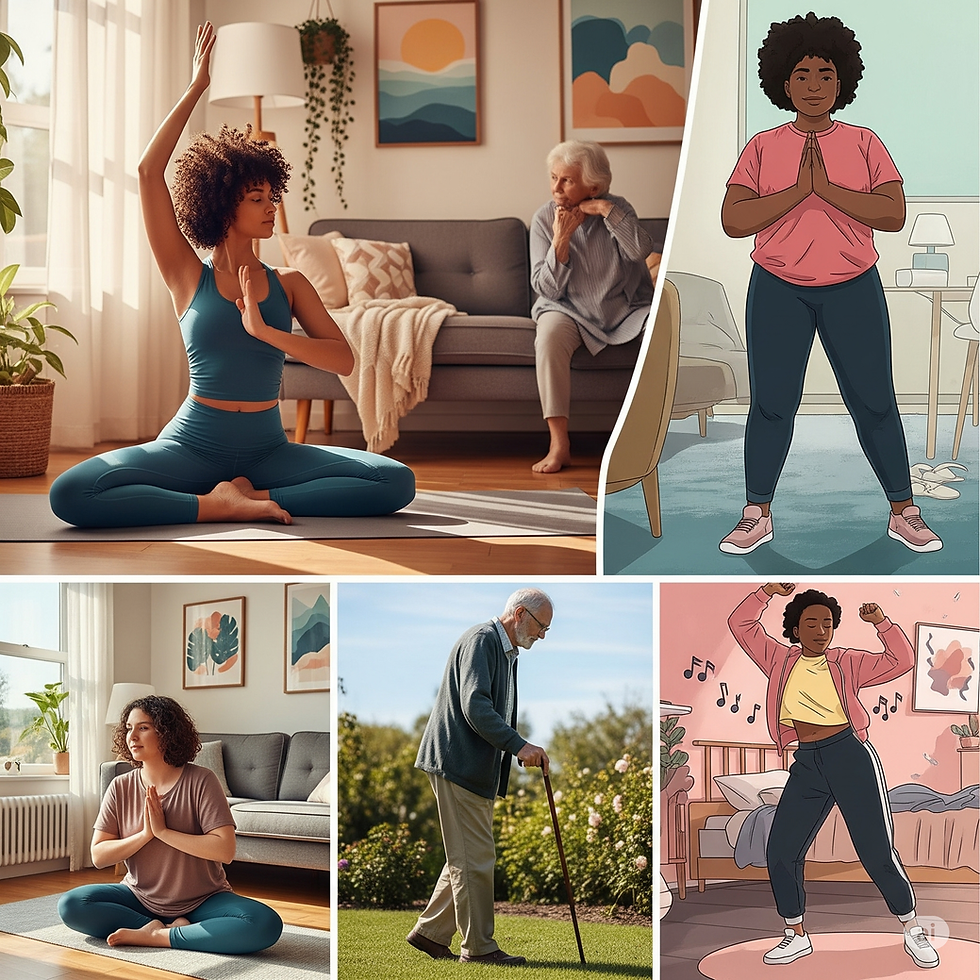
Walking laps in your living room because the thought of stepping outside makes your heart race.
Yoga poses done in bed, one leg at a time, because getting down on the floor feels like a full-body negotiation.
Squeezing in a few minutes of stretching during a pain flare—not to change your body, but to survive being in it.
Dancing slowly to your favorite sad girl playlist, letting your body process what your mouth can’t say.
Playing VR games like Beat Saber or Just Dance not because you’re chasing fitness goals, but because they help you forget the pain long enough to feel powerful again.
Crying in the middle of a movement—because suddenly you remember when you could do so much more, and the grief of that loss punches you in the chest.
And yes, it also looks like hope.
Hope that movement can still be yours, even if it’s different now.
Hope that healing isn’t linear, but it’s still happening.
Hope that your body, as complicated and battered as it may feel, is still worthy of love, care, and joy.
Because movement is medicine, even when it doesn’t come in reps or rounds.
Even when it hurts.
Even when all you can do… is breathe.
But Let’s Be Real: It’s Not Just Physical
Pain doesn’t start and stop with the body.
It’s woven through your thoughts, your memories, your survival responses.
It lingers in your muscles, yes—but also in your triggers, your flashbacks, your fear of not being believed or taken seriously.
Stress doesn’t just mess with your mind—it hijacks your whole nervous system.
Your jaw clenches.
Your shoulders tighten.
Your gut twists.
It’s fight-or-flight with nowhere to run.
I’ve been told by doctors and counselors (repeatedly, exhaustingly) to "find better ways to manage stress."
But they don’t see the invisible war I fight just to exist some days.
Back then, I could push through everything like a machine. Hustle was survival. Pain was background noise.
Now? Stress hurts. Like, physically hurts.
If I don’t take the time to calm my nervous system, the pain spikes.
My joints lock up.
My brain fog rolls in like a storm.
I feel like I’m dragging my body through molasses.
So I’m learning.
To pause.
To ground.
To choose softness when everything in me screams to shut down.
I’m learning that healing isn't just a mindset—it’s a full-body practice.
One that asks for patience, compassion, and flexibility.
And I’m inviting you to learn alongside me.
Not from a pedestal, but from the floor… probably with a heating pad, a messy bun, and a sleepy sigh.
We’re not broken. We’re becoming.
A Gentle Movement Routine for Painful Days
Here’s a short routine that’s helped me reintroduce movement without pushing past my limits. I worked with AI tools to flow the poses better—but I tested each of these personally. Always talk to your doctor or physical therapist before starting anything new. What works for me might not work for you, and that’s okay.
Disclaimer: Now I'm no expert when it comes to workouts—I’ve taken training, yes—but I'm not a licensed fitness trainer. So while I'm going to share a yoga routine that works for me, I highly suggest you speak to your doctor and a professional to make sure it's not going to do more harm than good for you. I want to stress this: every person’s body is different and has different needs. I'm just sharing my experience.
Now, as I said, I'm not an expert—so I looked up the names for the poses and movements I do and I asked Google’s Gemini to make the routine flow better for you than just doing the exercises as needed. As I said before, transparency is important to me, so I want to be clear when I'm using AI for more than just grammar and spelling.
Gentle Movement Routine for Chronic Pain
Setup: Find a quiet, cozy spot. Grab a yoga mat, cushions, a belt or scarf, and maybe a sturdy chair. You can do many of these in bed if needed.
1. Centering & Gentle Breathing (2 minutes)
Starting Position: Sit comfortably on the floor with legs crossed (use a cushion under your hips if your hips are tight) or sit upright in a sturdy chair with your feet flat on the floor.
Focus: Close your eyes or soften your gaze. Place one hand on your belly and the other on your chest.
Action: Take 5-10 slow, deep breaths, feeling your belly rise with each inhale and fall with each exhale. Let go of tension.
2. Seated Cat-Cow (3 minutes)
Starting Position: Sitting upright in a chair or on the floor with legs crossed. Hands gently resting on your knees.
Cat (Exhale): Gently round your spine, tuck your chin slightly towards your chest, and draw your navel towards your spine. (Imagine pulling your belly button back to touch your spine).
Cow (Inhale): Gently arch your lower back, lift your chest, and look slightly upwards (don't crane your neck).
Repetitions: Flow between Cat and Cow for 1-2 minutes, coordinating with your breath. Move slowly and gently.
Benefits: Gentle spinal mobility, relieves lower back stiffness.
3. Gentle Neck & Shoulder Rolls (2 minutes)
Starting Position: Seated comfortably, spine long.
Neck:
Action: Gently drop your right ear towards your right shoulder. Hold for a few breaths. Slowly bring your head back to center. Repeat on the left side.
Action: Gently lower your chin towards your chest. Hold for a few breaths. Slowly lift your head.
Avoid: Full neck circles if you have any neck issues.
Shoulders (Right Shoulder Focus):
Action: Shrug both shoulders up towards your ears, then slowly roll them down and back. Repeat 5-8 times.
Action (Right Shoulder Modification): Instead of large rolls, gently lift your right shoulder up slightly, then relax it down. Do this 5-10 times, focusing on relaxation. If you have an exercise band, you can do very gentle external rotations with the band anchored at elbow height with your elbow at your side and forearm parallel to the floor, if your doctor or physical therapist has cleared it. Otherwise, continue with gentle shrugs.
Benefits: Releases tension in the neck and upper back, gentle movement for the shoulders.
4. Supported Forward Fold (Sitting) (2 minutes)
Starting Position: Sit on the floor with your legs extended in front of you. Place a cushion under your hips if your hamstrings are tight.
Action: Gently hinge forward from your hips, keeping your back as straight as comfortable.
Modification for Low Flexibility: Keep your knees bent significantly.
Modification for Lower Back Pain: Do not fold deeply. Just lean forward slightly until you feel a gentle stretch in your hamstrings.
Modification for Carpal Tunnel: Rest your forearms on your thighs or a cushion in front of you, hands relaxed. Avoid putting weight on your wrists.
Goal: You want to feel a gentle stretch in the back of your thighs, not a strain in your lower back.
Hold: Hold for 5-8 breaths.
Benefits: Gentle hamstring stretch, lengthens the spine.
5. Knees-to-Chest (Supported on Back) (2 minutes)
Starting Position: Lie on your back (use a cushion under your head if needed). Bend your knees, feet flat on the floor.
Action:
Lower Back Pain Modification: Bring one knee towards your chest at a time, holding onto your thigh (not your shin, to protect your knee). Gently hug it in.
Action for both knees: If comfortable, bring both knees towards your chest. If you have a strap, you can loop it around your thighs and gently hold the ends to assist.
Hold: Hold for 5-8 breaths, feeling a gentle release in your lower back.
Benefits: Decompresses the lower spine, gentle stretch for the hips.
6. Supported Supine Twist (2 minutes)
Starting Position: Lying on your back, knees bent, feet flat on the floor.
Action:
Option 1 (Gentler): Let both knees gently fall to one side (e.g., right), keeping both shoulders as close to the floor as possible. Use a pillow or cushion under your knees if they don't reach the floor easily.
Option 2 (Slightly Deeper): If comfortable, bring your knees towards your chest, then let them fall to one side.
Head Position: If comfortable, turn your head to the opposite side of your knees.
Hold: Hold for 5-8 breaths on each side.
Benefits: Gentle spinal rotation, releases tension in the lower back and hips.
7. Resting Pose (Savasana - Modified) (2 minutes)
Starting Position: Lie on your back.
Modification for Lower Back Pain: Keep your knees bent, feet flat on the floor, or place a rolled blanket/pillow under your knees.
Modification for Carpal Tunnel: Rest your hands palms up, slightly away from your body, or place small cushions under your wrists for support.
Action: Close your eyes. Allow your body to feel heavy and relaxed on the floor. Focus on your breath, letting go of any remaining tension.
Benefits: Integration of the practice, deep relaxation.
You Deserve to Feel Good in Your Body
Not someday.
Not after you lose weight.
Not after your diagnosis.
Now.
Even if your body hurts.
Even if your mind is loud.
Even if you can only move for five minutes today.
You deserve a version of movement that meets you where you are. That honors your pain instead of ignoring it. That heals rather than punishes.
Come As You Are, Move As You Can
This isn’t about perfection. This is about presence. Whether you’re stretching in bed, pacing your hallway, or just thinking about moving—you're showing up. That matters.
So tell me—what’s one gentle thing you're doing for your body this week? No pressure, just connection. Comment below or DM me if you want to share privately. I’d love to cheer you on.
And remember: rest is part of the routine, too.


Comments